July 20, 2026
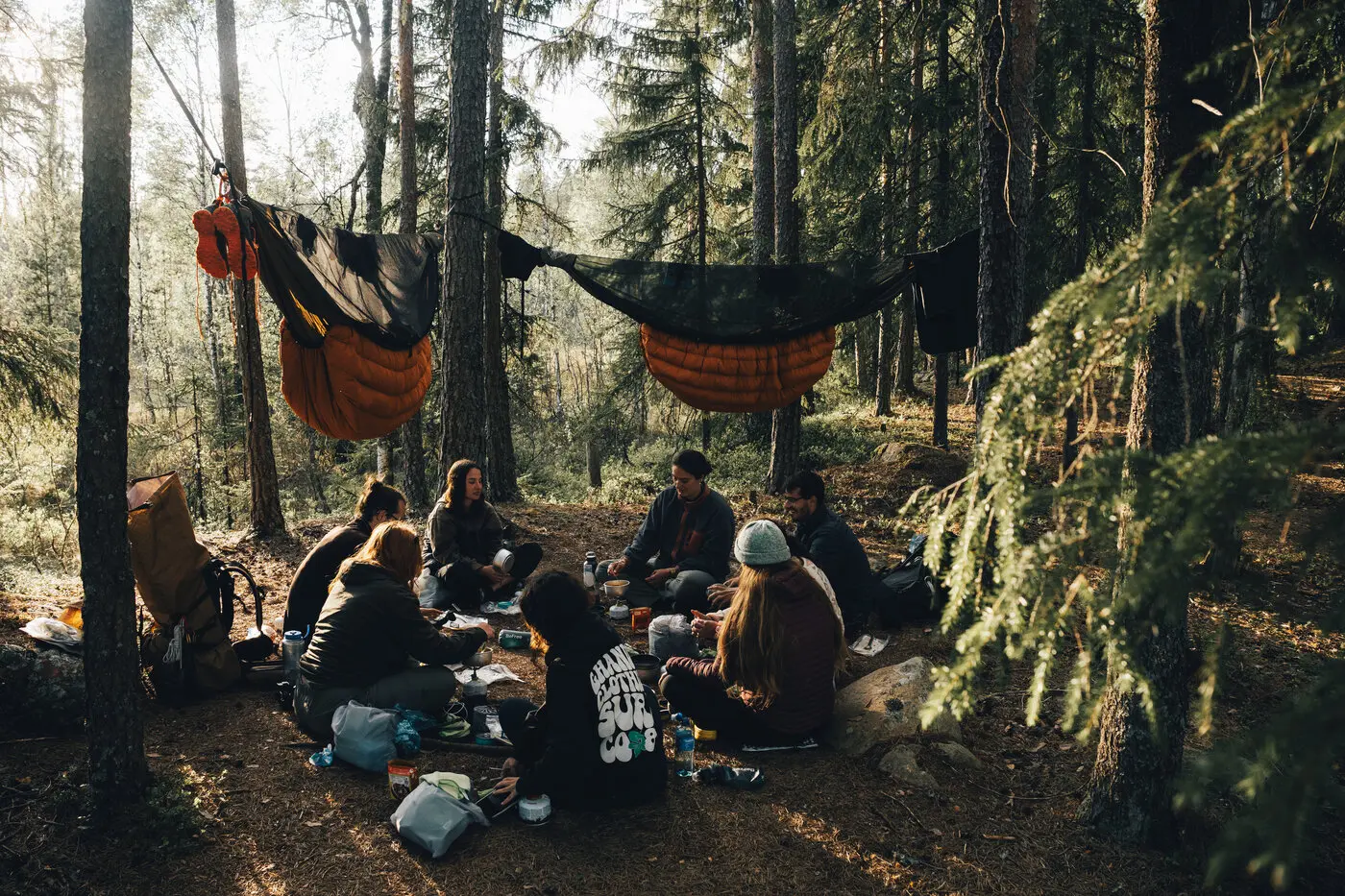
There is a Swedish word that does not translate cleanly into English. It is not hygge — that belongs to Denmark. It is not lagom, though that comes close. The word is friluftsliv: open-air living. The idea that being outside, unhurried and present, is not a hobby but a way of being.
A hammock is friluftsliv made physical.
This is why, in Sweden, you will find hammocks in places that would surprise you — strung between birch trees at a summer cottage, suspended in a light-filled apartment in Stockholm, tucked into the corner of a garden that gets exactly three hours of afternoon sun. The Swedes did not adopt the hammock because it was fashionable. They adopted it because it fits.
What Slow Living Actually Means in Sweden
Slow living is not laziness. In Sweden, it is almost a discipline. The concept of lagom — just the right amount — runs through Swedish culture like a quiet current. Not too much, not too little. The right pace, the right portion, the right level of effort. Applied to rest, lagom means: rest fully, when you rest. Do not half-rest while checking your phone. Do not rush your afternoon to get back to something productive. A hammock enforces this. You cannot really do anything else in a hammock. You can read, if the book is light enough. You can think. You can watch the way light moves through leaves. But you cannot multitask, and you cannot rush. The hammock will not allow it. This is, in Sweden, considered a feature.The Swedish Summer and Why It Changes Everything
Sweden has long winters. Very long. Dark by three in the afternoon, cold enough that outdoor life becomes genuinely difficult from October through April. And then, suddenly, summer arrives — and with it, a kind of collective exhale. Swedish summers are not merely pleasant. They are precious. The light lasts until nearly midnight in June and July. The air, finally warm, carries the smell of pine and water. People move outside — to their sommarstuga (summer cottage), to their allotment gardens, to the rocks along the coast — and they stay there. The hammock is the natural resting point of the Swedish summer. It belongs to that particular afternoon — the one that seems to last forever, where there is nowhere to be and nothing to do and the light is doing something extraordinary in the trees.Why Natural Materials Matter
The Swedish relationship with nature is not decorative. It is constitutional. The concept of allemansrätten — the right to roam — gives every person in Sweden legal access to forests, mountains and coastline, regardless of who owns the land. Nature is not a backdrop. It is a right. This extends to the objects Swedes choose to bring into nature. Synthetic fabrics, plastic components, materials that do not age well — these sit uneasily in a culture that values authenticity and environmental responsibility. A hammock made from natural cotton or linen, with a solid wooden frame, belongs in a Swedish garden in a way that a nylon camping hammock simply does not. It looks right. It feels right. And it will age into something more beautiful, not less, over the years it spends in Swedish summers.The Hammock as a Design Object
Swedish design has long understood that the most beautiful objects are also the most functional. Form follows function is not just a modernist principle — it is a Swedish instinct. A well-made hammock is an expression of this. The curve of the fabric follows the curve of the body. The wooden spreader bars hold the shape open, making it easy to get in and out, easy to lie flat. The natural fibres soften with use, conforming gradually to whoever lies in them. There is no decoration for decoration's sake. The beauty is in the making — in the tightness of the weave, the quality of the wood, the evenness of the hang. These are things you notice not when you first see the hammock, but after months and years of using it.Georgia and Sweden — An Unlikely Meeting
At LAGOM, we named our brand after the Swedish philosophy of balance. But our hammocks are made in Georgia — the country at the foot of the Caucasus mountains, where handweaving is not a craft revival but a living tradition. The meeting of these two cultures is, we think, exactly right. Georgia brings the making — the patient, skilled, generational knowledge of how to weave cotton and linen into something that will outlast the person who made it. Sweden brings the philosophy — the understanding that rest is not a reward for productivity but a practice in itself, worthy of beautiful objects and careful attention. When a LAGOM hammock arrives in a Swedish garden, something completes.How to Bring Slow Living Into Your Own Space
You do not need a summer cottage. You do not need a garden. You need two anchor points and the willingness to stop.- A balcony with two walls can hold a hammock on a freestanding stand
- An apartment with a load-bearing wall and enough floor space can become a reading corner unlike any other
- A garden, however small, becomes something else entirely when a hammock appears in it
- A terrace, a rooftop, a porch** — anywhere the light is good and the air moves