July 20, 2026
Not all hammocks are the same. The difference between a handmade cotton hammock and a mass-produced synthetic one is not a matter of price preference or aesthetic taste — it is a difference in what the object actually is, how it was made, and what it will become over the years you spend in it.
This guide walks through everything worth knowing before you buy.
Why Cotton — and Not Nylon
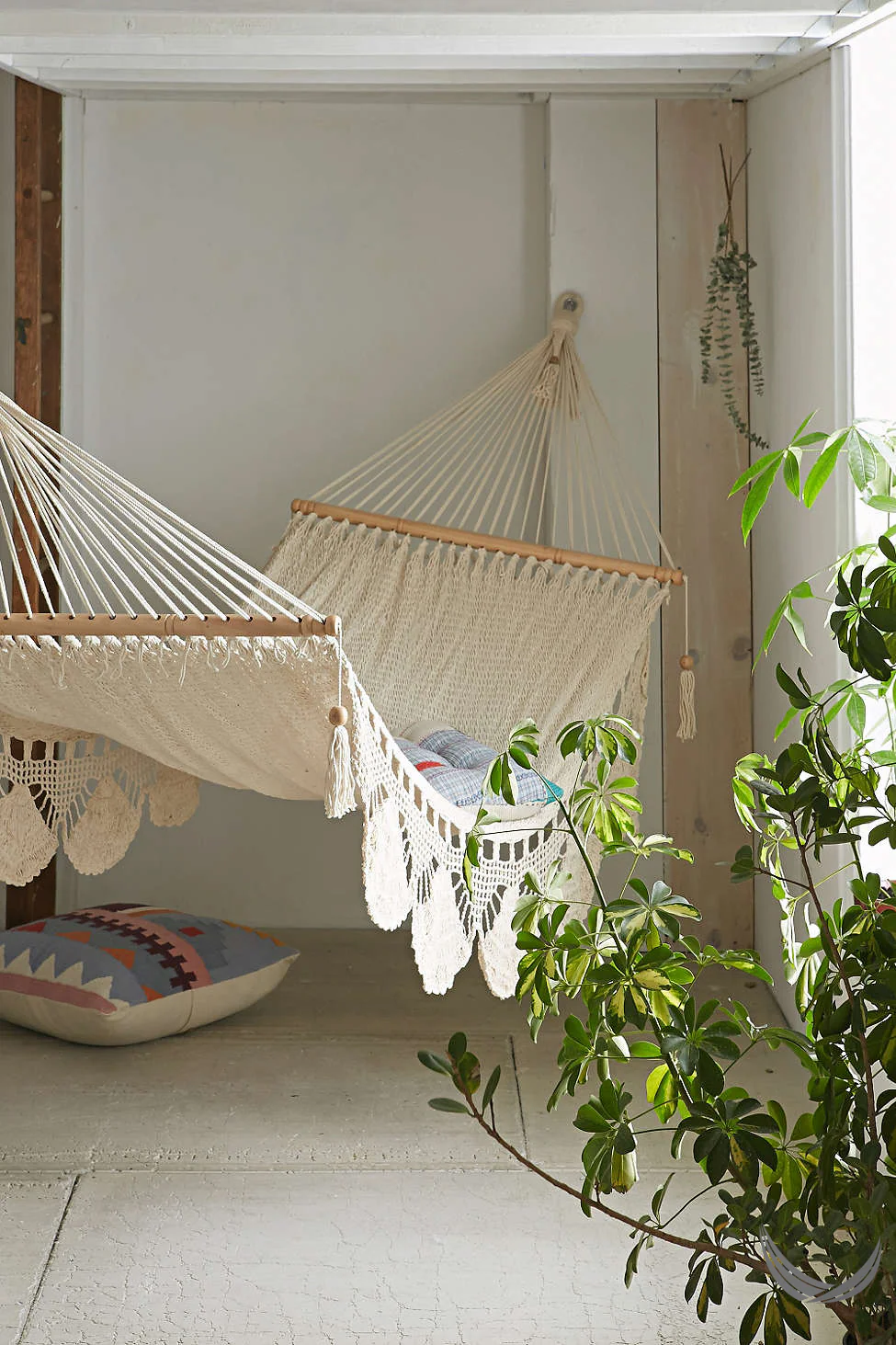
The modern hammock market is dominated by parachute nylon. It is light, it is cheap, and it is everywhere. It is also, for most purposes, the wrong material. Nylon does not breathe. On a warm afternoon — the kind of afternoon a hammock is made for — a nylon hammock traps heat against the body. It feels synthetic because it is synthetic. It has no texture, no softness, no quality that improves with time. Cotton is the opposite. It breathes naturally, keeping the body cool in summer and retaining a degree of warmth on cooler evenings. It softens with every use, conforming gradually to whoever lies in it. A cotton hammock in year three is noticeably better than it was on the day it arrived. Linen blend takes this further. Linen is lighter than pure cotton, dries faster after rain, and has a naturally cooler feel. It is the choice for those who want the qualities of natural fibre with slightly more performance in warm, humid conditions.- Cotton — soft, warm, improves with use, ideal for gardens and interiors
- Linen blend — lighter, faster drying, cooler feel, ideal for outdoor summer use
- Nylon/polyester — lightweight and waterproof, but synthetic, hot, and characterless
Handmade vs Machine-Made — What the Difference Actually Feels Like
A machine-woven hammock is consistent. Every thread is in exactly the right place. The tension is uniform. The finish is clean. It is also, in some hard-to-define way, inert. A handmade hammock carries something different. The weave has a slight variation — not a flaw, but a signature. The tension shifts subtly across the fabric, creating a surface that responds to the body in a more nuanced way. When you lie in a handwoven hammock, it feels like it is adapting to you, rather than simply holding you. This is not sentimentality. It is the physical consequence of human hands making decisions — thousands of small adjustments, corrections and choices — that a machine does not make. What to look for:- Visible weave variation — not uniformity
- Natural irregularity in the fringe or edging
- Weight — a handmade cotton hammock should feel substantial
- Evidence of origin — where was it made, and by whom
The Spreader Bar Question
Hammocks come in two basic configurations: with spreader bars and without. Without spreader bars — the traditional cocoon shape. The fabric wraps around the body, which many people find deeply comfortable. The entry and exit requires more care. Best for those who want to disappear into their hammock entirely. With spreader bars — the fabric is held open by wooden bars at each end, creating a flatter, more bed-like surface. Easier to get in and out of. Better for reading, or for anyone who finds the cocoon shape claustrophobic. For spreader bar hammocks, the material of the bar matters.- Solid oak — the benchmark. Heavy, durable, ages beautifully, does not warp in humidity
- Pine or spruce — lighter and less expensive, adequate for sheltered use
- Bamboo — looks appealing but splits over time, especially outdoors
- Painted or stained wood — check what is underneath. Cheap wood painted to look like hardwood is a common substitution
Size — Getting the Dimensions Right
The most common mistake when buying a hammock is choosing one that is too short. A hammock should be significantly longer than the person who uses it. The standard rule: add at least one metre to your height to find the minimum fabric length. For a person who is 1.8 metres tall, look for a hammock with at least 2.8 metres of fabric — ideally more. Why longer is better: The diagonal lie — lying slightly across the weave rather than straight along it — is the most comfortable position in a hammock. It flattens the curve, supports the spine, and allows the whole body to relax. A longer hammock gives you more room to find that diagonal.- Single hammock: fabric length 2.8 – 3.2 metres
- Double hammock: fabric length 3.2 – 4.0 metres, width 1.4 – 1.6 metres
- Total hanging length (including ropes or straps): add 1.5 – 2 metres to fabric length
What to Look at Before You Buy
The weave
Hold the hammock up to light. The weave should be tight and even, without gaps or loose threads. In a handmade cotton hammock, slight variation is normal and desirable. Significant irregularity — loose sections, pulled threads — is a sign of poor craftsmanship.The end loops or attachment points
This is where the hammock bears the most stress. The loops or rings at each end should be reinforced — doubled stitching, thickened fabric, or metal rings sewn into strong webbing. Weak attachment points are the most common point of failure.The fringe
On hammocks with decorative fringe, check that the fringe is knotted, not simply cut. Knotted fringe will not unravel. Cut fringe will, gradually, over several seasons.The weight rating
Any quality hammock should state a weight rating. For single use, 150 kg minimum. For double use, 250 kg minimum. If a hammock does not state a weight rating, treat that as a warning.Questions Worth Asking Before You Buy
- Where was it made? A country of origin matters — both for quality assurance and for the story the object carries.
- Who made it? Artisan-made and factory-made are different things. The difference is felt, not just claimed.
- What are the care instructions? A quality cotton hammock should be washable at 30°C, air-dried, and storable indoors in winter. If care instructions are absent, quality may be uncertain.
- Is there a warranty? A maker who stands behind their work will offer one.