August 17, 2026
Not everyone has two perfectly spaced trees in their garden. That's the entire premise behind the freestanding hammock — a hammock suspended not from trees or a porch, but from its own dedicated wooden stand. It's less romantic on paper than the classic image of a hammock strung between two oaks, but in practice, it solves nearly every problem that makes people hesitate to buy a hammock in the first place.
Why a Stand, Not Trees
The appeal is simple: placement freedom. A freestanding hammock can go anywhere — a stone patio, a balcony, the center of a lawn, a spot with no trees within fifty meters. You're not negotiating with the landscape. You decide where you want to spend your afternoons, and the hammock follows.
There's also a practical argument for longevity. Suspending a hammock from living trees means the tension shifts as the trees grow, sway in wind, or are pruned. A stand holds a fixed, engineered tension — consistent every time you lie down, for as long as the stand lasts.
Wood Matters More Than People Expect
Not all hammock stands are equal, and the wood is where the difference shows first.
Solid Oak — The Benchmark
Solid oak is dense, weather-resistant, and carries enough natural weight to stay stable without needing to be staked or anchored down — the stand's own mass does the work. Left untreated outdoors, oak develops a soft, silvery-grey patina over a few seasons. Kept indoors or under cover, it holds its warm, honey-toned color far longer.
Pine or Spruce — Lighter, Shorter-Lived
Pine or spruce stands are lighter and less expensive, which suits occasional or sheltered use, but they're softer woods — more prone to denting, warping in humidity, and generally shorter-lived outdoors.
The One to Watch For: Painted "Hardwood-Look" Stands
Cheap softwood, painted to resemble oak, is a common substitution in mass-produced stands. If a listing doesn't specify the wood species, that's usually a sign it's not solid hardwood.
At LAGOM, every stand we build uses solid oak, finished with natural oil rather than lacquer or synthetic coating — so the wood ages the way real wood should, not the way a factory finish wants it to.
The Curve Is Not Just Decoration
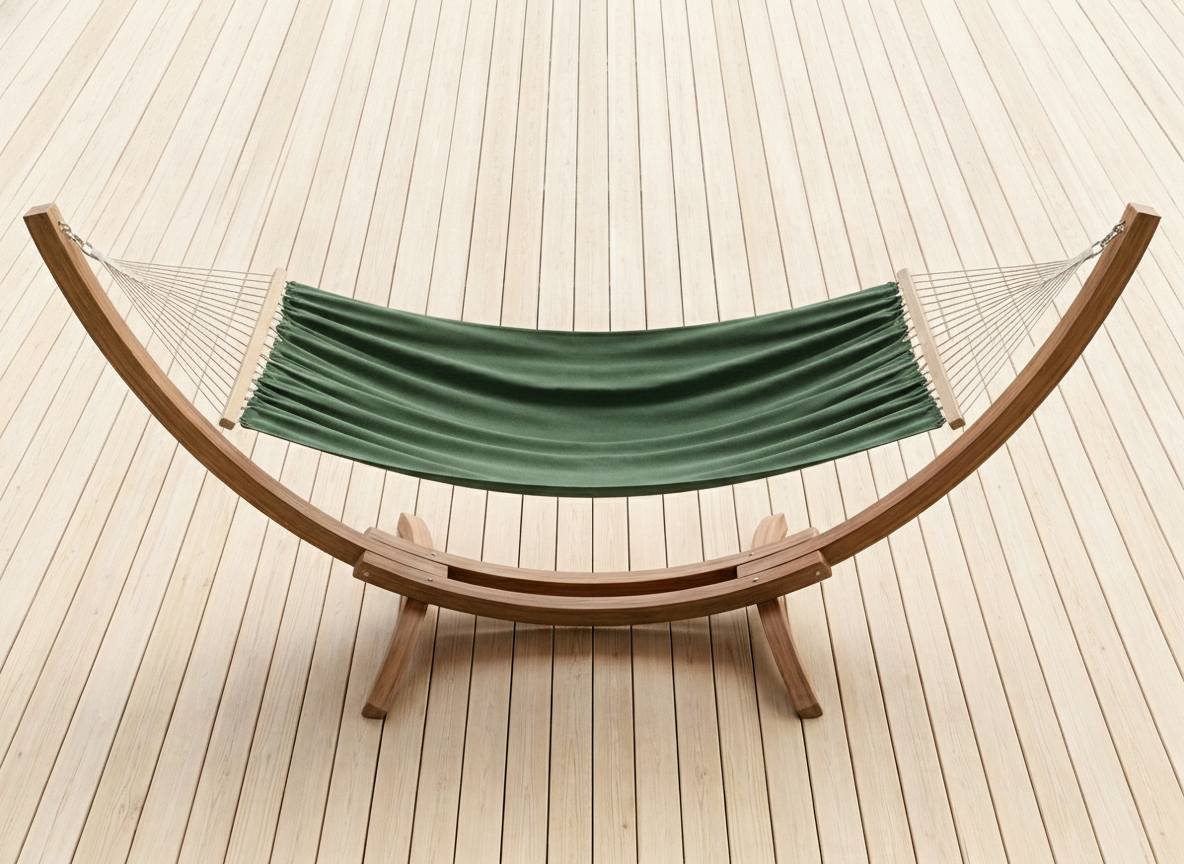
A well-made oak stand isn't a straight frame with a hammock hung between two posts — it's a single, continuous curved arc, and the curve does real structural and aesthetic work.
Structurally
An arched stand distributes weight along the full length of the curve rather than concentrating stress at two fixed joints, which is part of why a well-built curved stand can hold significant weight without flexing or creaking.
Aesthetically
The arc mirrors the natural curve of the hammock fabric hanging beneath it — the whole piece reads as one continuous shape rather than fabric awkwardly suspended between hard right angles. It's the difference between a hammock that looks assembled and one that looks designed.
Stability: What Actually Keeps It From Tipping
A freestanding stand needs to hold its own weight, plus whatever weight is lying in the hammock, without shifting. A few things determine this:
- Base width — a wider base footprint gives more resistance to tipping, especially for double hammocks, where the load isn't always centered
- Total weight of the stand — solid oak's density is an advantage here, since a heavier stand simply moves less
- Ground contact — stands with a flat, even base sit more securely on patios or decking; on grass or soil, check whether the stand has a mechanism to stay level on uneven ground
A stand rated for a specific hammock's weight capacity should be trusted over guesswork — pairing a lightweight stand with a heavy-duty double hammock is one of the more common mistakes buyers make.
Indoor or Outdoor?
A well-built oak stand works in both settings, but the wood's finish should match where it lives.
Outdoors
Oil-finished oak is built to face rain, sun, and temperature swings, developing that characteristic silvery patina over time — this is aging, not deterioration.
Indoors
The same stand keeps its warmer, richer tone far longer, since it's shielded from UV and moisture. An indoor freestanding hammock also works well as a genuine piece of furniture — a reading nook, a corner of a sunroom, a spot that would otherwise just be empty floor.
What to Check Before You Buy
- Wood species stated clearly (solid oak, not "hardwood" as a vague catch-all)
- Finish: natural oil (better for long-term aging) vs. lacquer or paint (can crack or peel over time)
- Stated weight capacity for the stand itself, not just the hammock fabric
- Base width relative to your intended hammock size — wider for doubles
- Whether the stand ships assembled or requires assembly, and how involved that process is
The Trade-Off, Honestly
A freestanding oak stand costs more than simply tying a hammock between two trees, and it takes up more physical space than a portable travel hammock. That's the honest trade-off. What you get in return is placement freedom, consistent tension that doesn't shift with a tree's growth, and — if you choose solid oak — a piece that's built to last for years rather than a single season.
Browse the full LAGOM collection, including our solid oak stand hammocks, at lagom-hammock.com.