August 17, 2026
The best hammock in the world is useless in the wrong spot. Too much sun and you'll never use it past 11am. Too little airflow and summer afternoons become unbearable. Wrong tree spacing and it either won't fit or won't hang right. Before you even think about fabric or frame style, it's worth thinking properly about where the hammock will actually live.
Reading Your Garden's Light
The ideal hammock spot gets morning sun and afternoon shade — or dappled light through leaves rather than direct exposure. A spot in full sun from noon onward will be too hot to enjoy for most of the day, and it accelerates fading in dyed fabrics.
Spend a day watching how light moves through your garden before committing to a spot. The perfect location often isn't obvious until you've actually watched the shadows shift.
Between Two Trees: Getting the Spacing Right
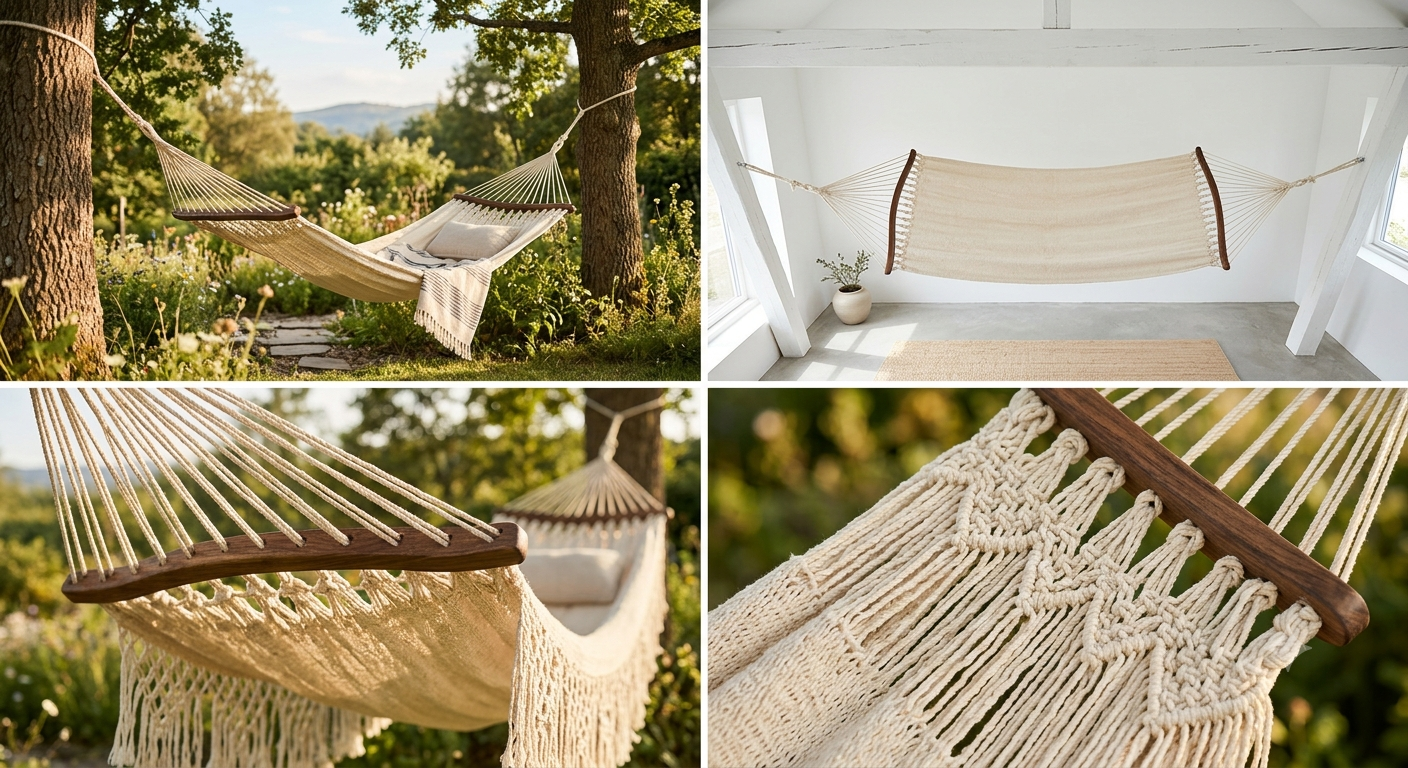
This is the classic setup, and it still works better than almost anything else — when the spacing is right.
- Trunk-to-trunk distance should be roughly 1–1.5 meters more than your hammock's fabric length, to account for the rope or strap hanging length at each end
- Both anchor points should be at a similar height — a steep incline between two mismatched heights puts uneven strain on the fabric and makes the hammock harder to get in and out of
- Choose mature, healthy trees — a trunk diameter of at least 15–20cm is a reasonable minimum for safely bearing a loaded hammock over time
- Hang at a height where the lowest point of the hammock sits 30–45cm off the ground when occupied — high enough to avoid dragging, low enough that getting in doesn't feel like a small athletic event
No Trees? A Freestanding Stand Solves It
If your garden doesn't have the right trees — or any trees at all — a freestanding stand removes the constraint entirely. It works on patios, balconies, gravel, decking, or the middle of an open lawn. The trade-off is cost and footprint, but the placement freedom is real: you can move it seasonally, angle it toward the best light, or reposition it entirely without touching a single tree.
Balconies and Terraces
Hammocks work on balconies more often than people assume, but the setup needs more care:
- Wall-mounted hooks need to be anchored into solid structure — masonry or a load-bearing stud, never drywall alone — and rated for well beyond your expected weight
- Check your building's balcony weight guidelines if you're in an apartment, particularly for a fixed wall mount
- A compact freestanding stand is often the safer, simpler option on a balcony, since it doesn't rely on the structure of the building at all
Indoor Hammocks: More Livable Than You'd Think
A hammock doesn't have to be a seasonal, outdoor-only object. Indoors, it works best in a room with enough open floor space to swing freely without hitting furniture — a sunroom, a converted attic corner, a spacious reading nook.
For indoor hanging, wall studs or ceiling joists are the only truly secure anchor points — never trust drywall or plaster alone. If you're not confident locating structural framing, a freestanding indoor stand avoids the question entirely and can be moved between rooms.
The Diagonal Space You Actually Need
People often measure the hanging distance but forget the sideways clearance. A hammock swings — gently in most cases, but it does move — so leave at least 60–80cm of clear space on either side, free of furniture, walls, or sharp corners.
A Quick Placement Checklist
- Morning sun, afternoon shade (or dappled light) rather than full sun all day
- Anchor points at similar height, spaced 1–1.5m more than your hammock's fabric length
- 30–45cm ground clearance when the hammock is loaded
- 60–80cm of clear space on either side for swing room
- Solid, load-rated anchor points — mature trees, masonry, or structural framing, never drywall alone
Whether you've got the perfect two trees, a bare balcony, or a sunny indoor corner, the LAGOM collection — including freestanding stand options — is built to fit the space you actually have. Browse it at lagom-hammock.com.